Articles


Why phonics still isn't working in many US classrooms
If almost every US state now requires research-based reading instruction, why are reading scores still falling? In 2024 a third of eighth graders scored below the Basic level in reading, the most in the test's history. In our experience teaching children to read English, more classrooms now teach phonics. But few schools make anyone responsible for whether each child masters it. Schools check that the lessons were covered. Few check what each child can now read on their own.
Scores fell even as reforms spread
The 2024 Nation's Report Card was bad across grades. About 40 percent of fourth graders scored below Basic, the highest share since 2002. Among high school seniors 32 percent did, also a record.
The pandemic and missed school days explain part of the drop. But schools have also had years of new laws, training and curricula, and scores are still falling.
Compliance became the goal instead of reading
Once states required materials aligned with the Science of Reading, everyone in the system needed to show they complied. Publishers show their products meet the rules. Schools show they bought the materials and finished the training. Teachers show they followed the curriculum.
None of this shows that a child has learned to read. A program can pass every review while its students keep struggling. The question that matters is what each child can now do alone.
Phonics taught is not phonics learned
When comprehension stays low, a common explanation is that schools focused too much on phonics and too little on vocabulary and background knowledge. That may be partly true. It skips a simpler question. Did the phonics stick?
A child can know letter sounds and read simple early books and still struggle with the long words and unusual spellings of later grades. Reading a word once with help is not the same as reading it fluently and spelling it alone.
When those skills are shaky, an older student who meets photosynthesis faces three problems at once. The pronunciation is new, the spelling is new and the idea is new. Calling all of this a lack of background knowledge misses the part that could have been taught in advance.
Teachers cannot add everything to one lesson
Reading depends on vocabulary, knowledge, sentence structure and inference. Knowing that does not tell a teacher how to build all of it for 25 children in one lesson.
When students fall behind, teachers are usually asked to add more explanation, vocabulary work, scaffolding and differentiation. Each request makes sense on its own. Taken together they are more than one classroom can carry. A program that only works when teachers find extra time and materials needs fixing.
Reading First showed the same pattern 20 years ago
Reading First, part of No Child Left Behind, spent about a billion dollars a year from 2002 on research-based reading instruction in low-income schools. The government's 2008 evaluation found that teachers spent more time on the five core parts of reading and that first graders decoded words better. Reading comprehension in grades one to three did not improve measurably.
Teachers changed what they covered. What students understood stayed the same.
England checks every six-year-old
Since 2012 every child in England reads 40 words aloud to a teacher at the end of year 1, around age six. Some of the words are made up, so the child cannot rely on memory. The check shows each school exactly which children have not yet mastered decoding.
The share of children meeting the expected standard rose from 58 percent in 2012 to 82 percent in 2019. In the 2021 PIRLS international reading study England ranked fourth of 43 countries. The check alone does not explain those results. But it makes every school answerable for each child's decoding.
Mastery needs an owner
- Give phonics its own protected time and a trained teacher who is responsible for each child's progress.
- Define success as things a child can do: read accurately and fluently, spell independently and use the same method on new words. Finishing the workbook does not count.
- Keep teaching past the early grades. A student who has not mastered these skills by third grade still needs phonics lessons, not just more reading assignments.
- Prepare words before they are needed. Students can learn to read and spell photosynthesis before the science lesson, so the lesson can focus on the idea.
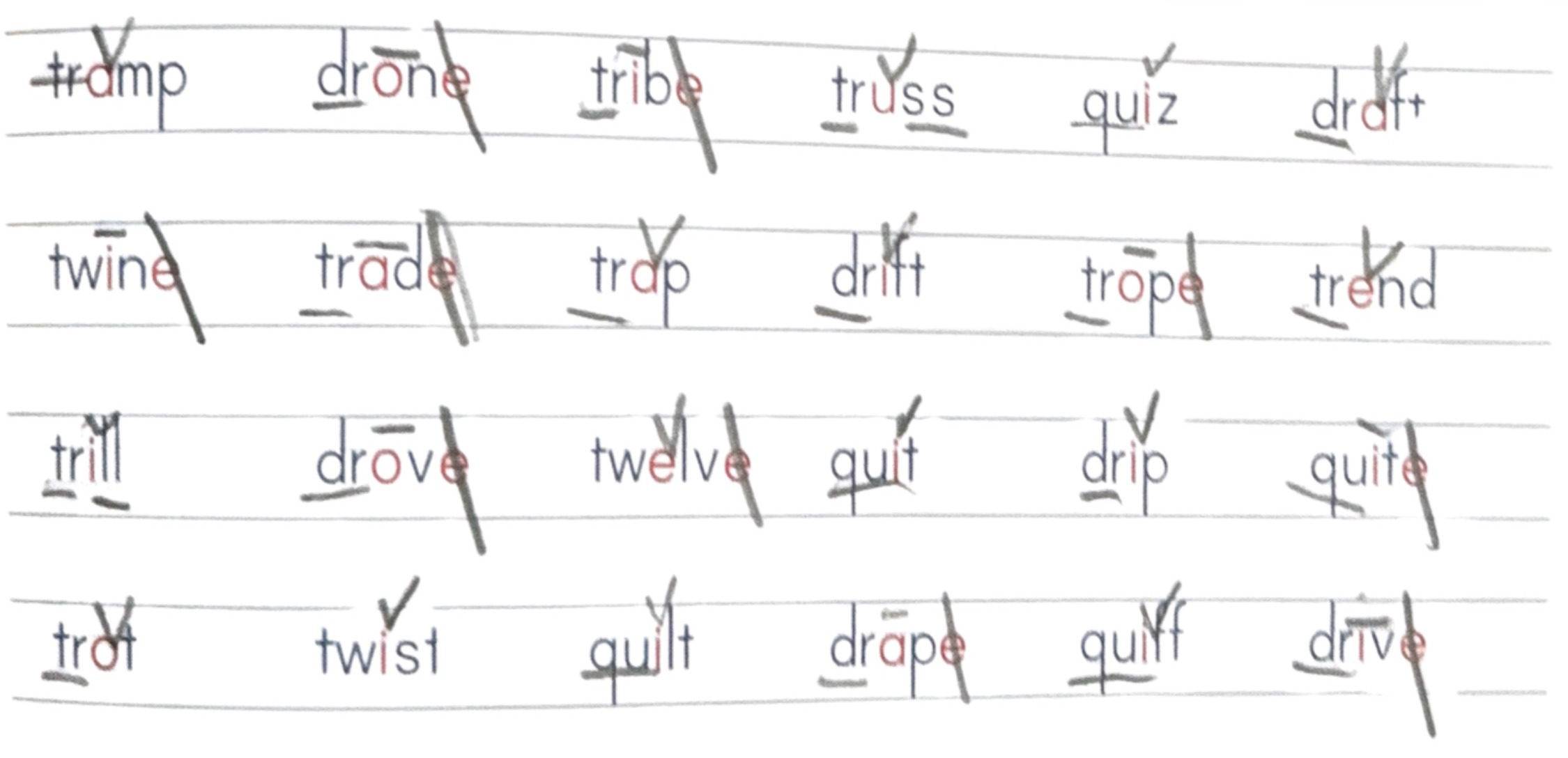
Octophonics is a dedicated phonics course built for this kind of mastery. Pronunciation marks on ordinary spelling let students read and spell any marked word on their own. See how it works.
Sources
- 2024 NAEP reading results, grades 4 and 8 (National Assessment Governing Board)
- 5 takeaways from 12th grade NAEP math and reading results (NAGB)
- Science of Reading laws: let's begin with the facts (Shanker Institute)
- Reading First Impact Study: Final Report (Institute of Education Sciences, 2008)
- Phonics screening check and key stage 1 assessments in England, 2019 (Department for Education)
- England moves to fourth in international rankings for reading (Department for Education)