Articles

A brief history of Science of Reading
Is the Science of Reading a new teaching method? The research behind it goes back more than fifty years. Psychologists, linguists and neuroscientists have long studied how children learn to read, and they largely agree. The new part is the movement. Parents, journalists and lawmakers have started asking why schools were not using the research. For anyone choosing a reading program today, the lesson is that the science is settled. The hard part is making sure each child masters the skills.
For decades schools argued over two methods
For much of the twentieth century English-speaking schools argued about how to teach reading.
Phonics taught children how letters stand for sounds and how to blend sounds into words. It was clear and easy to teach. What it did not explain was how a child goes from sounding out every word to recognizing words instantly.
Whole language spread from the 1970s. It treated reading as a natural process like learning to talk. Children would learn by being surrounded by good books, with meaning first and rules second. Many teachers liked it.
Whole language came with a word-reading method often called three-cueing. A child who did not know a word was told to use the picture, the sentence and the first letter. A child who read pony where the text said horse was accepted because the meaning fit. Reading Recovery, developed by Marie Clay in New Zealand and widely used in the US from the 1980s, took a similar approach with struggling first graders.
Research kept pointing back to sounds and letters
- 1967. Jeanne Chall's Learning to Read: The Great Debate compared methods and found that early systematic phonics gave children a stronger start.
- 1983. Lynette Bradley and Peter Bryant showed that training young children to hear sounds in words improved their later reading and spelling.
- 1986. Philip Gough and William Tunmer proposed the Simple View of Reading. Comprehension is the product of word recognition and language comprehension. If either is close to zero, so is understanding.
- 1990. Marilyn Jager Adams's Beginning to Read pulled together the research on letters, sounds, word recognition and meaning. Children need both phonics and meaning.
- 1995. David Share explained how children teach themselves new words. Each time a child sounds out a word successfully, the child gets a chance to store its spelling. No teacher can teach every word, so this self-teaching matters.
- 1998. Preventing Reading Difficulties in Young Children argued for preventing reading problems early instead of fixing them later.
- 2000. The National Reading Panel reviewed the research and named five components of reading instruction: phonemic awareness, phonics, fluency, vocabulary and comprehension.
- 2001. Hollis Scarborough's Reading Rope showed skilled reading as strands of word recognition and language comprehension twisting together.
- 2014. Linnea Ehri summarized years of work on orthographic mapping. This is how a word's spelling becomes tied to its sounds and meaning in memory so it can be read on sight.
Neuroscience added another piece. Stanislas Dehaene and colleagues showed that the brain has no built-in reading system because writing is too recent. Learning to read means repurposing circuits that evolved for other jobs. That is one reason reading has to be taught.
The research also showed why three-cueing fails. Skilled readers recognize words quickly and accurately with no context at all. Weaker readers are the ones who lean on pictures and guessing. Context helps a reader understand what a word means. Using it to guess what a word is builds the wrong habit.
Since 2018 the research has become a movement
An earlier push came with the federal Reading First program in 2002. A 2008 evaluation found that it improved decoding but not comprehension, and its funding was cut.
Interest returned in 2018. That year Anne Castles, Kathleen Rastle and Kate Nation published Ending the Reading Wars, a summary of how children go from beginners to skilled readers. A few months later journalist Emily Hanford released Hard Words, an audio documentary asking why schools were not teaching reading the way the research said.
In 2022 Hanford followed with Sold a Story, a podcast tracing how three-cueing spread through teacher training and best-selling curricula. Since then nearly every state has passed laws on reading instruction. Many of them name the Science of Reading directly.
Knowing the science is easy. Making each child master it is hard.
Researchers largely agree on how children learn to read. Getting that into classrooms is harder. Teachers need training. Schools need the right materials. And each child needs to master the skills, not just cover them.
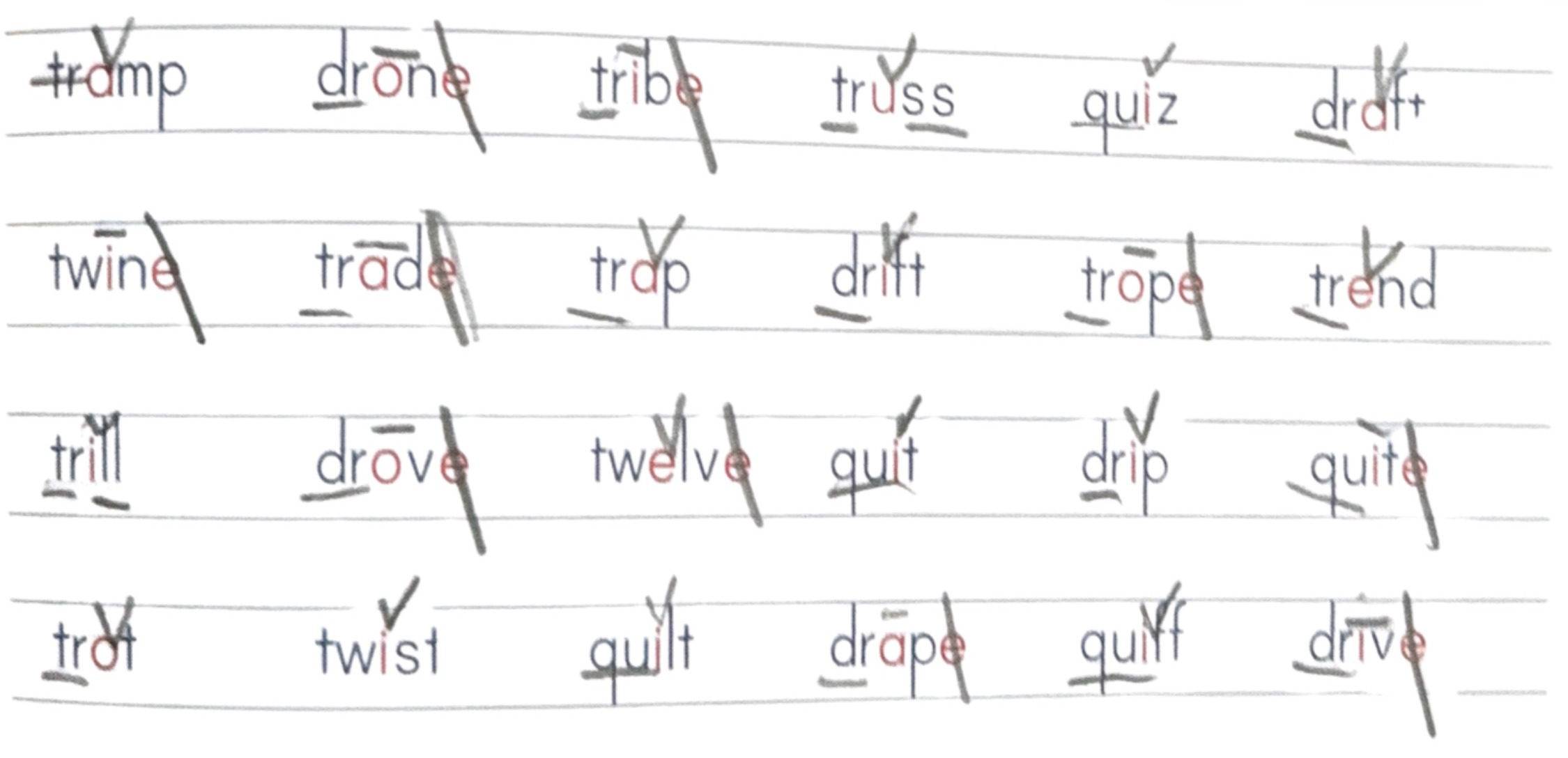
Octophonics is a phonics course built around that last step. It puts pronunciation marks on ordinary spelling so children can read and spell new words on their own. See how it works.
Sources
- Learning to Read: The Great Debate (Chall, 1967)
- Categorizing sounds and learning to read: a causal connection (Bradley and Bryant, Nature, 1983)
- Beginning to Read (Adams, MIT Press, 1990)
- Phonological recoding and self-teaching (Share, 1995)
- Preventing Reading Difficulties in Young Children (National Academies, 1998)
- Report of the National Reading Panel (NICHD, 2000)
- Orthographic mapping in the acquisition of sight word reading (Ehri, 2014)
- Cultural recycling of cortical maps (Dehaene and Cohen, 2007)
- Reading First Impact Study: Final Report (IES, 2008)
- Ending the Reading Wars (Castles, Rastle and Nation, 2018)
- Hard Words (APM Reports, 2018)
- Sold a Story (APM Reports, 2022)
- Science of Reading laws: let's begin with the facts (Shanker Institute)