文章

Why English is so hard to learn to read
Why can a child in Finland or Italy read simple words by the end of the first school year, while an English-speaking child of the same age still struggles? The main reason is English spelling. Most of the difficulty sits in the vowels, and the most common vowel sound in English has no letter of its own. Teaching children to see which sound each vowel makes removes much of the problem.
English has 26 letters for about 44 sounds
Those 44 sounds can be spelled in more than 200 ways. The sound /f/ can be written f (fun), ff (puff), ph (phone) or gh (laugh). The letter a sounds different in cat, cake, car, call and about. A beginning reader looking at a vowel often cannot tell which sound to use.
Linguists call this a deep spelling system. In shallow systems like Finnish, Spanish and Italian, each letter almost always makes the same sound. Once a child knows the letters, the child can read nearly any word.
Learning to read English takes more than twice as long
In 2003 a team led by Philip Seymour tested first-year readers in 13 European languages. In most countries children read simple real words and made-up words accurately before the end of the first year. English-speaking children were furthest behind. The researchers estimated that early reading in English develops more than twice as slowly as in languages with consistent spelling.
Two features of English explain the gap. Its syllables are complex, with clusters like str and nds. And its spelling is inconsistent.
The most common vowel sound has no letter
That sound is the schwa. It is the soft "uh" in unstressed syllables, like the first a in about, the o in lemon, the i in pencil and the last a in animal.
The schwa appears in a large share of longer words and can be spelled with any vowel letter. This is one reason so many long words look irregular. In family or vegetable the letters suggest one pronunciation and the spoken word uses another.
Many phonics programs teach the five short vowels and a set of long-vowel rules, then leave schwa to chance. Children who read cat and cake with ease often struggle in second and third grade, when texts have more long words.
Second-language learners cannot check their guesses
A native speaker who sounds out a word slightly wrong can often fix it because the half-said word sounds familiar. A child learning English as a second language usually cannot. If the word is not in the child's spoken vocabulary, there is nothing to check the guess against. For these children accurate decoding matters even more.
Hearing the English vowels is a separate challenge. We cover it in our article on phonemic awareness.
Teaching vowels and schwa directly closes the gap
English can be taught systematically. Children need more than the alphabet.
- Teach sounds, not letter names. A child needs to know that a makes several sounds and which one to use.
- Start with the vowel. It is the hardest part of an English word to predict, so it deserves attention first.
- Teach common endings as units. Endings like -tion, -al, -ous and -er appear in thousands of words and are nearly always said the same way.
- Teach schwa directly. Show children where it appears so they do not have to guess.
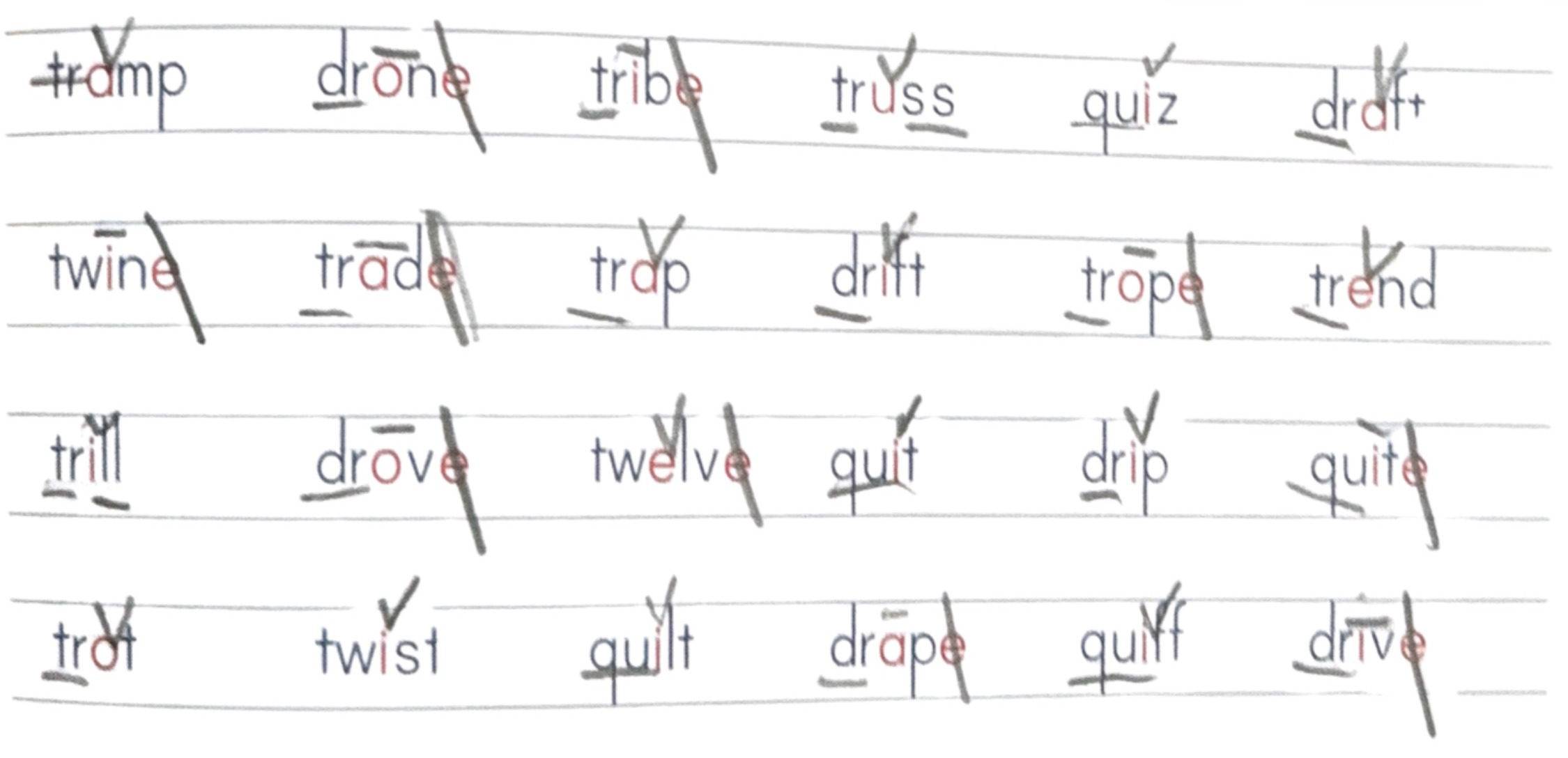
Octophonics adds small pronunciation marks to ordinary English spelling, including a mark for schwa. Children see which sound each vowel makes while reading real words. See how it works.
Sources
- Foundation literacy acquisition in European orthographies (Seymour, Aro and Erskine, British Journal of Psychology, 2003)
- The 44 phonemes of English (Reading Rockets)
- Which vowels are used most in English? (Styles, 2018)